The Face on Mars
A hill, a shadow, and a speckled photograph
On 25 July 1976, official wording says, NASA’s Viking 1 Orbiter photographed a region in the northern latitudes of Mars while searching for a landing site for Viking 2. A NASA Science page dated 31 July 1976 published the still, and made the hill famous.[source][source]
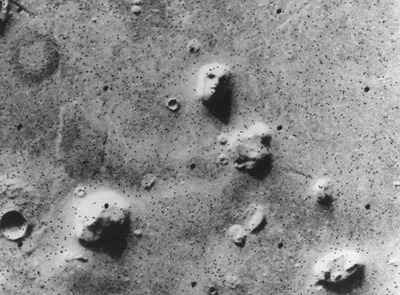
“The picture shows eroded mesa-like landforms.” Then the sentence almost everyone remembers: “The huge rock formation in the center, which resembles a human head, is formed by shadows giving the illusion of eyes, nose and mouth.” Official wording calls it an illusion, and a resemblance — not a carving.[source]
The same official 1976 caption gives a size and a sun angle: “The feature is 1.5 kilometers (one mile) across, with the sun angle at approximately 20 degrees.” It was “taken on July 25 from a range of 1873 kilometers (1162 miles).” The page, writing in that summer, also says Viking 2 “will arrive in Mars orbit next Saturday (August 7) with a landing scheduled for early September.” That official future tense stays with the dated page.[source]
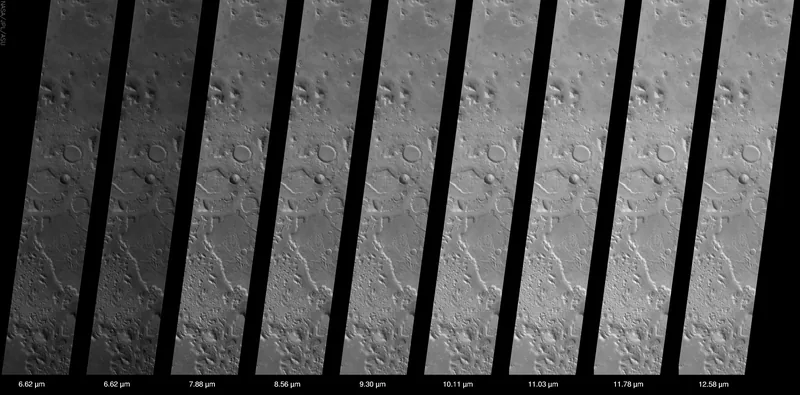
Look closely at the official 1976 still, and it is speckled. “The speckled appearance of the image is due to bit errors, emphasized by enlargement of the photo,” the 31 July 1976 page says. A later official caption, PIA01141, does not use that same sentence. It says the speckles are “missing data, called bit errors, caused by problems in transmission of the photographic data from Mars to Earth.” And then a detail that is almost too good: “Bit errors comprise part of one of the ‘eyes’ and ‘nostrils’ on the eroded rock that resembles a human face near the center of the image.”[source]
Official PIA01141 wording also says “Shadows in the rock formation give the illusion of a nose and mouth,” and “Planetary geologists attribute the origin of the formation to purely natural processes.” The official 640 × 472 JPEG is the still on this page. A larger “Original (1669×1899)” offered on another NASA page is not treated here as the same photograph.[source][source]
Enjoyed this desk of faces that are not there?
No pop-ups. No intrusive advertising. Just interesting stuff. A little support helps the next illusions.im site get built.