Discoveries
Sixteen stories from the official record
16 researched discoveries, each tied to an official Encyclopaedia Britannica or NASA sentence.
A habit with an official name
Official Britannica wording: in pareidolia, “illusory perception is visual,” and people tend to see familiar patterns, such as faces or objects, in random stimuli.[source]
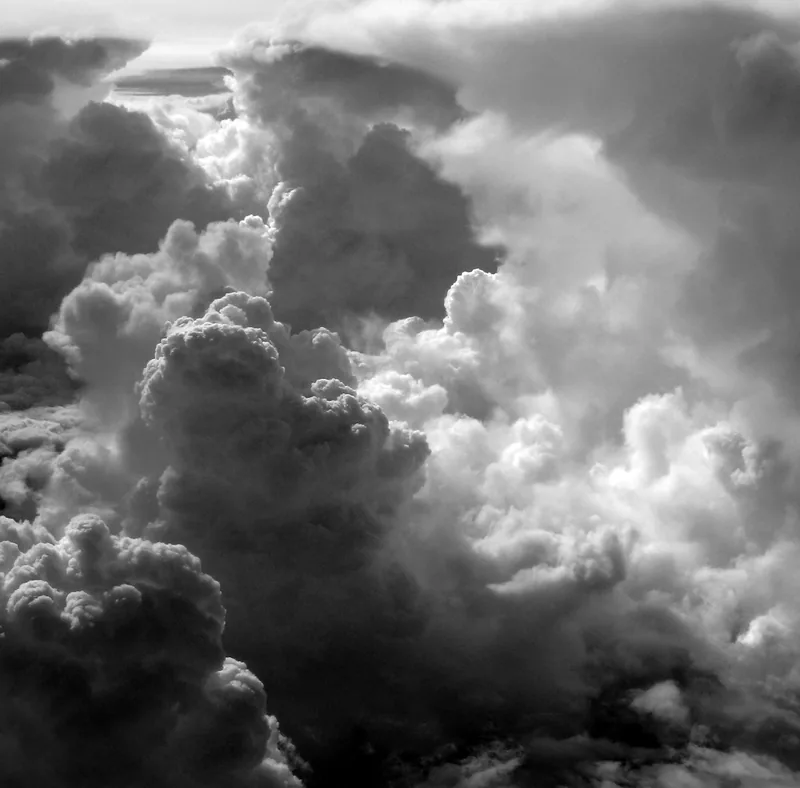
Cumulus clouds seen from a passenger plane, photographed by Kevin Dooley on 5 August 2007, as the file states. Encyclopaedia Britannica’s official example is that a person may see “images of animals or figures in clouds or rock formations.” This photograph is of clouds; this site does not name a particular animal or figure in it. Licensed CC BY 2.0. Photo: Kevin Dooley, 5 August 2007 · CC BY 2.0 · Wikimedia Commons Where none exists
A NASA Science blog’s official sentence: seeing familiar patterns or objects “where none exists” is called pareidolia.[source]
A hill in the northern latitudes
Official 1976 wording: a Viking 1 Orbiter picture, taken in the northern latitudes of Mars, while searching for a landing site for Viking 2.[source]
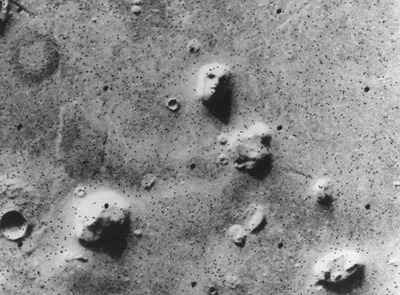
The official PIA01141 still, taken by NASA’s Viking 1 Orbiter on 25 July 1976 in the northern latitudes of Mars, while searching for a landing site for Viking 2. Official wording: the huge rock formation in the centre “resembles a human head” and “is formed by shadows giving the illusion of eyes, nose and mouth.” The speckled appearance is due to bit errors. This is the official 640 × 472 JPEG; a larger “Original (1669×1899)” offered on another NASA page is not treated here as the same still. Public domain, NASA/JPL-Caltech. Photo: NASA / Viking 1 Orbiter, 25 July 1976 · Public domain (NASA/JPL-Caltech) · NASA / JPL-Caltech An illusion of eyes, nose and mouth
“The huge rock formation in the center, which resembles a human head, is formed by shadows giving the illusion of eyes, nose and mouth.”[source]
Bit errors in an eye
Official PIA01141 wording: bit errors, from missing data in transmission, “comprise part of one of the ‘eyes’ and ‘nostrils.’”[source]
One mile across
Official 1976 and PIA01141 wording: “The feature is 1.5 kilometers (one mile) across,” with the sun angle at approximately 20 degrees.[source][source]
A 3-km long knob
Official THEMIS wording, not blended with the mile, calls it a “3-km long knob.”[source]
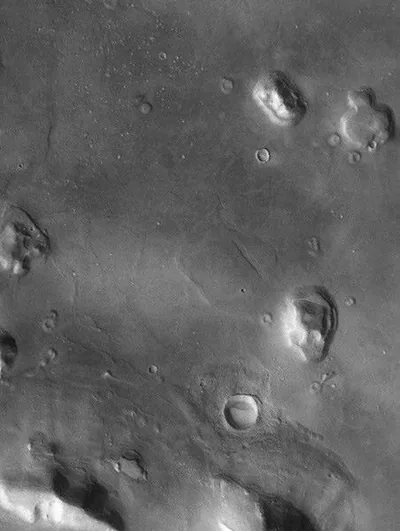
A mid-swath detail of the official PIA03768 JPEG (full file 452 × 1280), released 13 April 2002. Official wording: “The so called ‘Face on Mars’ can be seen slightly above center and to the right in this THEMIS visible image.” The caption does not, beyond that phrase, point to a single hill in this crop as “the” Face. This still is not given the 1976 “1.5 kilometers (one mile) across” figure; official THEMIS wording calls it a “3-km long knob.” Public domain, NASA/JPL-Caltech/Arizona State University. Photo: NASA / 2001 Mars Odyssey THEMIS, released 13 April 2002 · Public domain (NASA/JPL-Caltech/Arizona State University) · NASA / JPL-Caltech / Arizona State University A normal geologic feature
Official wording: later detailed views “clearly show that it is a normal geologic feature with slopes and ridges carved by eons of wind and downslope motion due to gravity.”[source]
Only in certain light, officially
Official blog wording: the landform “only appears to resemble a ‘face’ in low-resolution images with very specific lighting.”[source]
A jumble of knobs
Official infrared wording: Cydonia is covered with dozens of similar knobs and mesas — “so many in fact that it requires care to discover the “face” among this jumble.”[source]
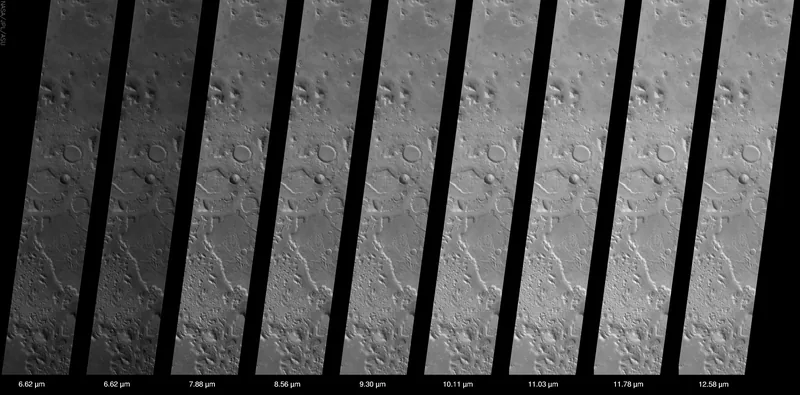
The official PIA03905 still, a THEMIS infrared view released 24 July 2002. Official wording: in this “big picture” view, Cydonia “is seen to be covered with dozens of interesting knobs and mesas that are similar in many ways to the knob named the “face” — so many in fact that it requires care to discover the “face” among this jumble of knobs and hills.” Public domain, NASA/JPL/Arizona State University. Photo: NASA / 2001 Mars Odyssey THEMIS, released 24 July 2002 · Public domain (NASA/JPL/Arizona State University) · NASA / JPL / Arizona State University Two official maps
Official visible THEMIS wording locates the knob near 10° N, 40° W (320° E). Official infrared wording locates it near 40° N, 10° W (350 ° E). Both are kept.[source][source]
Camelback Mountain
Official THEMIS wording: a similar-size hill in Phoenix “resembles a camel lying on the ground,” and Phoenicians “whimsically refer to it as Camelback Mountain.”[source]
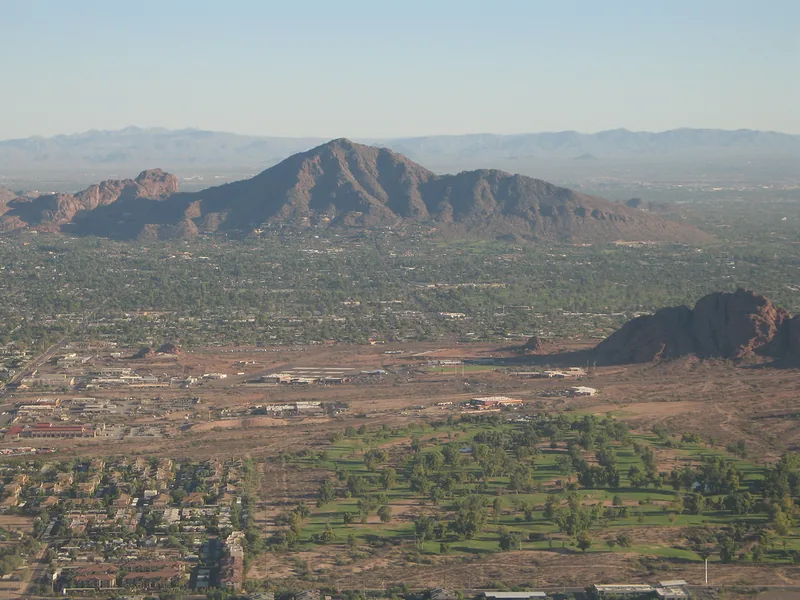
Camelback Mountain, near Phoenix, Arizona, photographed by Adrienne Lahr on 20 September 2007. A NASA THEMIS caption compares a Martian hill with “a similar-size hill in Phoenix, Arizona” that “resembles a camel lying on the ground,” and says “Phoenicians whimsically refer to it as Camelback Mountain.” This photograph is of that mountain; it is not a photograph of Mars. Licensed CC BY 2.0. Photo: Adrienne Lahr, 20 September 2007 · CC BY 2.0 · Wikimedia Commons / Flickr, Outdoorsy Lady Ledges on the slopes
Official wording: many knobs, including the “Face,” have flat ledges of more resistant rock, the last remnants of layers that once ran across the region.[source]
Purely natural processes
Official PIA01141 wording: “Planetary geologists attribute the origin of the formation to purely natural processes.”[source]
A blog’s account of Sagan
The official NASA blog summarises Carl Sagan’s 1995 book as saying that identifying patterns was a vital evolutionary survival skill. That is the blog’s account, not a quotation from the book.[source]
Animals or figures, unnamed
Official Britannica wording allows that a person may see animals or figures in clouds or rock formations. Photographs on this site are not given invented names of that kind.[source]
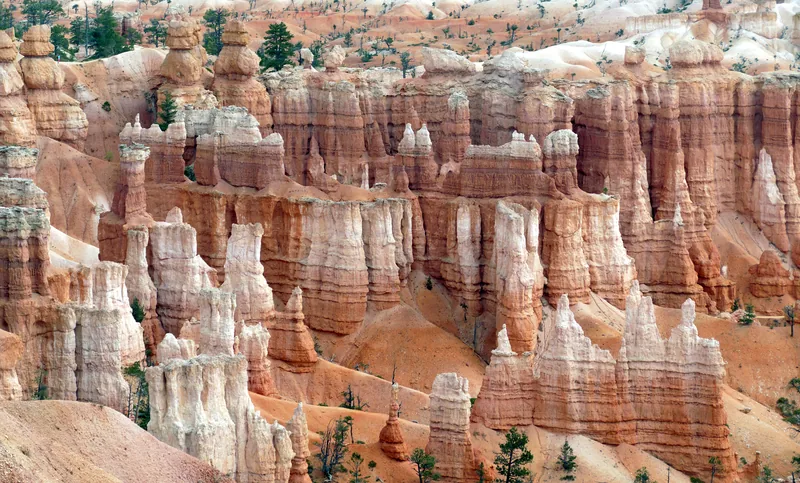
Hoodoos in Bryce Canyon, photographed by Bernard Spragg. NZ on 28 October 2016. The file lists other names for such forms — fairy chimneys, earth pyramids, tent rocks — as names, not as a single official geological term used here. Public domain dedication, CC0. Photo: Bernard Spragg. NZ, 28 October 2016 · CC0 · Wikimedia Commons / Flickr
Enjoyed this desk of faces that are not there?
No pop-ups. No intrusive advertising. Just interesting stuff. A little support helps the next illusions.im site get built.