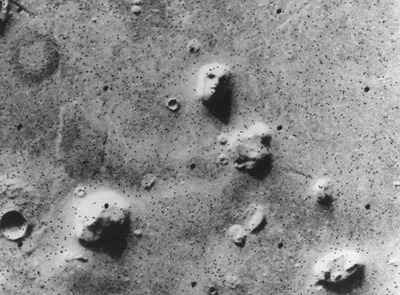
A speckled photograph from 1976 made a Martian hill famous. Official wording is careful: shadows gave “the illusion of eyes, nose and mouth.” Bit errors, official pages later said, even comprise part of one of the “eyes.”[source][source]
The official PIA01141 still, taken by NASA’s Viking 1 Orbiter on 25 July 1976 in the northern latitudes of Mars, while searching for a landing site for Viking 2. Official wording: the huge rock formation in the centre “resembles a human head” and “is formed by shadows giving the illusion of eyes, nose and mouth.” The speckled appearance is due to bit errors. This is the official 640 × 472 JPEG; a larger “Original (1669×1899)” offered on another NASA page is not treated here as the same still. Public domain, NASA/JPL-Caltech.Photo: NASA / Viking 1 Orbiter, 25 July 1976 · Public domain (NASA/JPL-Caltech) · NASA / JPL-Caltech
Is it a face?
Pick a story. Official pages treat pareidolia as a visual habit — seeing a familiar pattern in something random — and they keep more than one official measurement of a famous Martian hill.
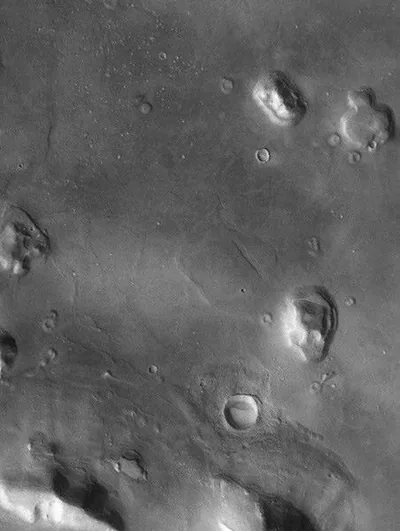
A mid-swath detail of the official PIA03768 JPEG (full file 452 × 1280), released 13 April 2002. Official wording: “The so called ‘Face on Mars’ can be seen slightly above center and to the right in this THEMIS visible image.” The caption does not, beyond that phrase, point to a single hill in this crop as “the” Face. This still is not given the 1976 “1.5 kilometers (one mile) across” figure; official THEMIS wording calls it a “3-km long knob.” Public domain, NASA/JPL-Caltech/Arizona State University.Photo: NASA / 2001 Mars Odyssey THEMIS, released 13 April 2002 · Public domain (NASA/JPL-Caltech/Arizona State University) · NASA / JPL-Caltech / Arizona State University
Encyclopaedia Britannica has a short official name for the habit itself. “In pareidolia, illusory perception is visual,” and people “tend to see familiar patterns, such as faces or objects, in random stimuli” — animals or figures in clouds or rock formations, for example. A NASA Science blog puts it another official way: seeing familiar patterns or objects “where none exists.” This desk keeps both wordings, rather than stirring them into one definition.[source][source]
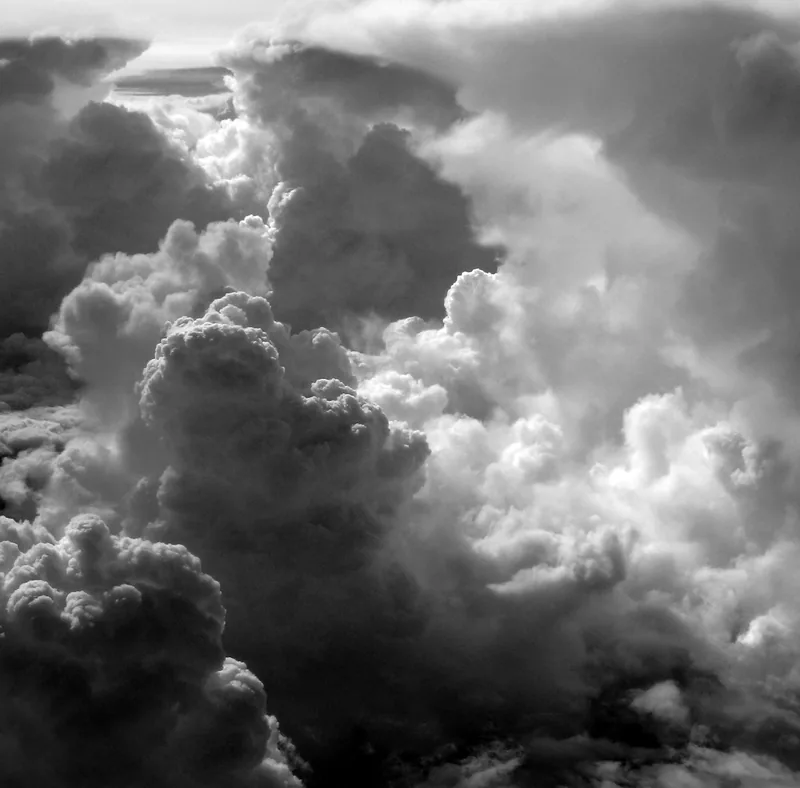
Cumulus clouds seen from a passenger plane, photographed by Kevin Dooley on 5 August 2007, as the file states. Encyclopaedia Britannica’s official example is that a person may see “images of animals or figures in clouds or rock formations.” This photograph is of clouds; this site does not name a particular animal or figure in it. Licensed CC BY 2.0.Photo: Kevin Dooley, 5 August 2007 · CC BY 2.0 · Wikimedia Commons
Then come the official measurements, which do not quite agree, and are much more interesting for that. A 1976 NASA caption says the feature is “1.5 kilometers (one mile) across.” A 2002 THEMIS caption calls the same famous knob “3-km long.” This site does not split the difference.[source][source]
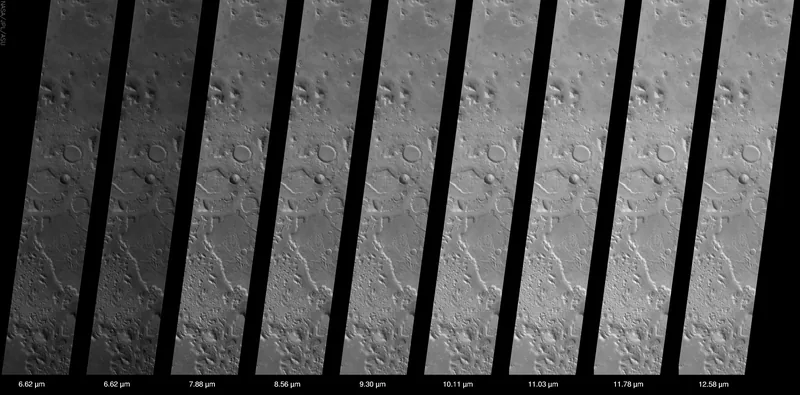
The official PIA03905 still, a THEMIS infrared view released 24 July 2002. Official wording: in this “big picture” view, Cydonia “is seen to be covered with dozens of interesting knobs and mesas that are similar in many ways to the knob named the “face” — so many in fact that it requires care to discover the “face” among this jumble of knobs and hills.” Public domain, NASA/JPL/Arizona State University.Photo: NASA / 2001 Mars Odyssey THEMIS, released 24 July 2002 · Public domain (NASA/JPL/Arizona State University) · NASA / JPL / Arizona State University
Later official pictures do not cancel that 1976 caption. An infrared view, official wording says, is so full of similar knobs and mesas “that it requires care to discover the “face” among this jumble.” A THEMIS caption even looks back at Earth: a similar-size hill in Phoenix “resembles a camel lying on the ground,” and Phoenicians “whimsically refer to it as Camelback Mountain.”[source][source]
Keep the lights on
Enjoyed this desk of faces that are not there?
No pop-ups. No intrusive advertising. Just interesting stuff. A little support helps the next illusions.im site get built.